
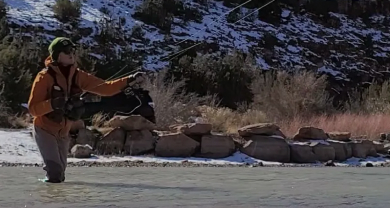


Welcome back to Tying Tuesday! This week, we’re in the studio with Ben, who’s diving into the details of a killer worm pattern – the Heavy Metal Worm. Get ready to learn the step-by-step for this powerhouse fly, designed to sink fast and attract strikes in even the trickiest waters.
Tips & Tricks
Euro-nymphing with heavy worm fly patterns can be highly effective, especially in fast or deep water where getting your fly to the right depth quickly is essential. Here are some tips and tricks to maximize your success:
1. Choose the Right Worm Fly Pattern
Worm patterns like the Squirmy Worm or San Juan Worm in vibrant colors (pink, red, chartreuse) can be irresistible to trout, especially after rainfall or in runoff conditions.
Use tungsten beads on your worm flies for extra weight. The tungsten gets your fly down fast, even in strong currents, which is crucial in Euro-nymphing.
2. Adjust Weight for Water Conditions
In faster water, use heavier worm patterns to reach the strike zone quickly. For slower or shallower water, scale back to lighter weights to maintain a natural drift.
If your fly isn’t reaching the bottom, consider adding a split shot or switching to a larger tungsten-beaded worm pattern to ensure you’re at the right depth.
3. Tight Line Control
Euro-nymphing relies on a tight line for instant feedback on strikes, so keep your line as taut as possible.
Position your rod tip slightly downstream to keep tension on your fly, giving you better strike detection and ensuring the fly moves naturally along the bottom.
4. Short Leader, High Stiffness
A shorter, stiffer leader will help you feel subtle strikes more easily and prevent unwanted slack in your line.
Use a colored sighter (a section of bright mono or braid in your leader) to improve strike detection. Watch for any twitch or pause, as it often indicates a take.
5. Focus on Depth Control
Aim to have your worm fly ticking along the bottom, making occasional contact with the substrate. Adjust your rod height and lead angle to control depth.
In deep water, consider using a double nymph rig with the worm as the anchor fly. This way, the worm sinks quickly and maintains bottom contact while allowing a lighter, smaller nymph to drift naturally above it.
6. Adjust Drift and Tension Regularly
Vary the speed and angle of your drift to mimic natural movement and cover different sections of the water column.
Keep the rod tip angled to adjust the fly’s depth and speed constantly, allowing the fly to drift naturally with the current.
7. Experiment with Presentation Angles
When possible, work your worm fly at different angles to find the most productive approach. A direct upstream or downstream cast can work well, but slightly angling across the current may produce more natural drifts.
Avoid casting perpendicular to the current, as this can create unnatural drag and reduce strike potential.
8. Read Water to Find Holding Spots
Trout often hold in areas where fast and slow currents meet, known as seams. Heavy worm patterns are ideal for getting down into these zones.
Focus on pockets behind rocks, deep runs, or near undercut banks, where fish lie waiting for food to drift by.
9. Stay Alert for Subtle Takes
Euro-nymphing with worm patterns often produces subtle strikes, so be ready to set the hook at any hint of resistance.
Sometimes, it’s easy to confuse bottom contact with a take. Err on the side of caution and set the hook if you’re unsure—it’s better to miss a bump on the bottom than to miss a fish.
10. Practice Hook Sets and Drift Techniques
A quick, firm hook set is crucial in Euro-nymphing. Practice timing your hook sets to ensure you capitalize on every take.
Master various drift techniques like jigging and tight-line drifting to give your worm pattern a lifelike appearance. These can trigger strikes from even the most cautious fish.
11. Match Fly Color to Conditions
Experiment with color variations based on water conditions. Brighter colors like pink or red tend to work well in stained or murky water, while darker, more muted tones may be more effective in clear water.
With these tips, you can maximize the effectiveness of Euro-nymphing with heavy worm fly patterns, reaching the right depths, achieving natural presentations, and increasing your hook-up rates.
Please Note: Part of this content was created using AI tools, reviewed, and edited by our team to ensure accuracy.
Ingredients & Recipe:
• Hook: Tiemco 105 – Size 8
• Bead: Fullling Mill Tungsten Bead, Light Pink, Size 5/32
• Legs: Fulling Mill Flexi Floss, FL. Pink
• Thread: UTC Ultra Thread, 140D, FL Pink
• Wire Rib: Semperfli Tying Wire, .3MM, Baby Pink
• Dubbing Collar: Hareline ICE Dub, FL Pink
Check out some of our favorite Fly Tying Gear:
- Vise – Dynaking Barracuda Deluxe Pedestal Vise
- Scissors – Kopter ABSOLUTE Blade Micro Serrated Edge Thin Point
- Bodkin – Dr. Slick Jumbo Carbon Fiber Bodkin
- Whip Finisher – Tiemco Midge Whip Finisher
- Tool Kit – Umpqua Dream Stream Plus 7 Piece Fly Tying Tool Kit
