



By John O’ Bryan
I’m not a journal keeper like some of my friends who keep track of everything related to what they did to catch fish on any given day. This sport can be so fluid and an ever-moving target that I don’t find a lot of benefit in keeping detailed notes. I’m also lazy, which doesn’t help, but I am glad there are people like this in the world. One of my favorite books on fishing is not even a fly-fishing book, but a gear fishing book called Striking Steelhead. The author documents every aspect of every day he was on the Clearwater River. Whenever he caught a fish he took the time to measure things like barometric pressure, river levels, sediment in the river, time of day, weather, phase of the moon, what he had for breakfast, whether he was in a good mood, whether he had clipped his fingernails and whether he drove well on the way to the river. I’m exaggerating a bit, but it’s a very detailed book and has been the sole reason that I am able to catch large, angry fish on that river.
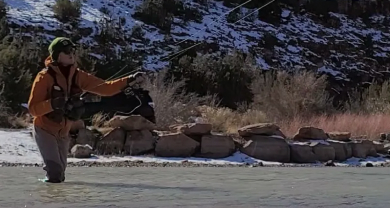
I often think that I should keep better fishing notes, but when I’m done fishing, I tend to look at the day as a whole and try to remember at least one thing the fish taught me that will help me fish better next time. One particular day when I was fishing Clayton Creek in North Idaho, I learned a valuable lesson. The fish weren’t biting, at least not for me. I’m usually okay with not catching fish because I love everything about being on the river, but not on this day. I was frustrated. Something was different and I didn’t know what it was or how to solve the problem. I knew that this stretch of water was holding large fish, yet they weren’t interested in anything I threw at them.
I was desperate and so I knelt in the water right where I had been standing. I didn’t pray, though maybe I should have, but dug my bare hands into the sand, scooped it out and began sifting through it like a gold panner looking for nuggets. As the sediment washed through my fingers, five or six really nice nuggets settled into my palm… but they weren’t gold.
What I held in my hand were tiny, green “Darnsel” fly nymphs, at least that’s what our family called them. You might know them as Damsel fly nymphs, but when my kids were little, I made a temporary name change from “Damsel” to “Darnsel” so I wouldn’t lose my mind. The change came about on a day I was fishing with my son next to a very large concrete river obstruction. “Dad!” he screamed at me, “Can I use the DAMsel fly next to the DAM? He was emphasizing every dam syllable. “Wow! That’s a big DAM. I love nothing better than fishing with DAMsel flies next to such a big DAM. I could fish next to this DAM with the DAMsel flies all damn day….” It was hard not to laugh, but I gave him my unhappy dad face. He just smiled and pointed sheepishly at the dam then turned back to the river.
As I knelt by the side of the river, I knew these darn little larvae were the answer to my problem. I didn’t have an exact match in my fly box, so I tied on an olive-colored pattern that was about the same size and shape and cast it into the current. On that very cast I caught nothing. However, this nothing was a much better nothing than the previous nothings because now I knew I was ACTUALLY fishing and not just casting. A few drifts later and I hooked a very nice Western Slope Cutthroat. It wasn’t the biggest fish I had ever caught, but it was one of the most satisfying.
I still don’t keep track of all the variables during a day of fishing, but I do often think about that one fish as I head to the river. That cutthroat made me realize that fishing is probably a lot easier than I think and the countless books and articles that I own about the art of catching fish with a fly are probably mostly unnecessary. I mean the fish and the river will always tell me what I need to know… I just need to learn to listen.


Well said John!