



By Dale Martens
Much has been written about “swing season” for trout. During a Canadian prairie winter, the only thing scarcer than a trout river, is open water to swing a fly. Nevertheless, in late February, with snow on the ground and ice on the water, the odd day gets above freezing, and screams for people to go fishing without an auger.
Newly retired, with the goal of learning to spey cast, I hear these screams louder than most. Luckily, I live reasonably close to a short, powerful river that connects two large lakes. There is an ice-free section below a control dam, and it attracts a large population of tullibee – also called cisco.
Tullibee are related to whitefish. A 16-incher is a true trophy. Nevertheless, they are insect eaters, and attractive targets after four months of winter. So, on February 27th, when the forecast called for a sunny afternoon close to 40 degrees, I pointed my car toward them.
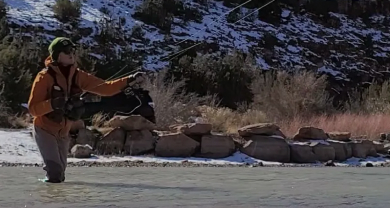
As I drove, I watched the sun disappear and the car thermometer crash. When I got to the river, the sky was ominous, the temperature was 25 degrees, and the wind was biting. Nevertheless, I pulled on a down parka and neoprene waders. This is one situation where breathable waders are not the answer. After two trips inside the car to warm up my hands, a 3-weight trout spey was rigged with a short Skagit head and a 10’ fast sinking tip.
There was nobody at the river. On one side of the dam, a section of frozen foam had pushed against the shore. It looked very cool, like floating rose petals, but was impenetrable. The other side was promising; steep riprap dropped quickly into a large eddy. There was no room for a back cast, and it begged for my spey rod.
I happily obliged, and after an hour-and-a-half, brought a few tullibee to hand. They nailed a small minnow imitation sunk deep on the heavy tip. Even with my newbie technique, it was easy to shoot 20 feet of running line and drop the fly where the fish were.
I had actually heard about this spot while attending a local fly-tying class several years ago. I now wish I had tried it sooner. If you keep your eyes and ears open, and maybe even grind out a few Google searches, you never know what kind of opportunities might present themselves during a snowy winter.

Bio: Dale Martens: I am a retired physics teacher who lives in Winnipeg, Manitoba. I love travel and believe that in order to truly experience a destination, you have to sample its fly fishing. One of my retirement goals is to put to use all the gear I’ve accumulated…
