

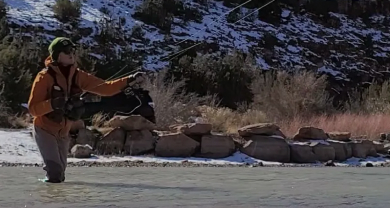


By Tanner King
Just the other day, I was taking a look at the fly-fishing reports for some of my local waters, and all the author had to say was two words, “winter conditions.” It is as if fly fishing in December is a hazardous road condition. So, I figured I better get out and take advantage of these “winter conditions.”
During the winter months, it is essential to think about the water temperatures and how they relate to your success on the water. Water temperatures below forty degrees suggest the fish will be more lethargic and less active. These cooler temperatures create a great excuse to get onto the water later in the day; I try to start my “winter conditions” fishing around eleven to noon and fish until four-thirty or five to allow the water to warm up. Another great way to battle these colder water temperatures is to focus your attention on tailwaters, given that the dams will create a more consistent temperature for the fish. Another great place to focus would be rivers and streams with natural hot springs flowing through them; the fish will most likely be hanging out and more active just below these hot springs where the water temperature is more to their liking. As mentioned earlier, while the water temperatures are cooling off, causing the fish to be more lethargic and less active, it is best to focus on slower water where the fish are less likely to exert more energy. A better understanding of trout behavior in cooler water temperatures and how to handle those temperatures is a great start for fly fishing in “winter conditions.”
Now that the where and when to fly fish in “winter conditions” have been handled, it is just as important to address what to bring to keep you out on the water longer and have the most fun and success possible. My best friend Scott is always harping on the saying, “It is easier to stay warm than it is to get warm.” Scott is most certainly right about that, so having plenty of layers is essential to staying warm while fishing in “winter conditions.” While having several layers and adjusting my layers throughout the day as the temperature changes, I find it most helpful to carry a backpack where I can stash my unused layers, fly boxes, snacks, and even a Jetboil to be able to make some hot coffee or apple cider to keep me going throughout the day. Lately, I have been using a Simms Dry Creek Z Backpack, which is perfect given that it is fully waterproof, has a built-in net holster for easy access, and has plenty of room to carry all my gear and essentials. One piece of gear that I always make sure to have handy is a small hand towel that allows me to dry off my hands after shaking hands with a buttery brown trout. Having this simple piece of gear allows me to continue using good catch-and-release practices while keeping my hands dry and warm. Speaking of hands, I also carry a pair of Simms fingerless wool gloves, which allows me to manage my fly line accurately (remember to take them off when handling trout so that you do not wipe off their slime). Typically, when I am out on the water, I am wade fishing; I have heard that waders with built-in boots provide the maximum amount of warmth, but lately, I have been wearing a pair of Seirus Heatwave Hiking Socks, which works as a “thermodynamic liner,” I wear these under a thick pear of wool socks and have had no issues yet. The last piece of gear made for “winter conditions” is Loon Stanley’s Ice Off Paste, which I have found to be very helpful at keeping my guides free of ice and able to continue casting throughout the day. These are just a few suggestions to stay out on the water longer.
As many experts say, the fly is the most essential piece of equipment while out on the water. While out fly fishing during “winter conditions,” fishing subsurface is often the most productive approach. I always bring several types of flies when fishing in these “winter conditions,” such as streamers, midges, and nymphs. When the temperatures are low, and I am having a hard time finding any insects to imitate, I throw my streamers. I usually begin by allowing my streamer to dead-drift through the slow water seams. After a few attempts, I will change my approach by casting the streamer out and slowly retrieving it through the water column to imitate an easy meal for a lethargic, unsuspecting trout. On many of my local waters during this time of year, I am always productive by using midge patterns such as the Griffiths Nat, Bunny Midge, Crystal Flash Midge, and Zebra Midge. While fishing these patterns, I attach a strike indicator at the appropriate length, typically twelve to twenty-four inches from the fly, where I will have the fly dead drift through the slower seams, mending my line and creating the most natural presentation possible. When fishing these midges, I typically size down a little on my tippet, given that the water levels will be at their lowest and sometimes their most transparent, and the fish will be wearier of predators.
Overall, when looking at fishing reports for this time of year and with limited information, the best option is to go out and make a few casts. Because the fish are still out there, they are still hungry, and the fishing is still a lot of fun. The best piece of advice that I have picked up while fishing during the winter is to approach each hole as stealthy as possible and see what works best for you. I think fly fishing in the winter can be just as fun as fly fishing in July; however, you are most likely not able to fish with a size 12 caddis fly and make a trout rise, you will most certainly be able to have the majority of the river to yourself given that many people either do not know that you can fly fish in the winter or do not want to get out in the cold. Nevertheless, if you are of a warm heart and up for an adventure, I wish you the best of luck this winter while fishing in those “winter conditions.”
Bio: “My name is Tanner King. I am from Rio Rancho, New Mexico, where I enjoy tying flies and wading out to see what works. My Instagram is the_tanner_king. “
