



By Ross Izard
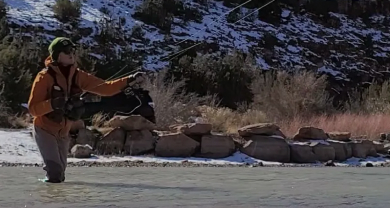
When winter arrives, a lot of fly fishers hang up waders and settle for long hours at the tying vise. But you don’t have to stop fishing because there’s ice on the banks—you just have to hit the water dressed for success.
I have always loved the saying that there is no bad weather, only bad gear. There’s nowhere on Earth where that aphorism holds truer than it does when you’re standing knee deep in water only a couple degrees above freezing in a sunless canyon on a cold February morning. Winter fly fishing, with its combination of cold air temps and near-freezing water temps, is a uniquely challenging outdoor activity when it comes to apparel.
If you roll up to the river with your warm-weather gear, you’re going to have a bad time. Your feet will be so cold they hurt. You may find yourself shivering from early-stage hypothermia, where you can’t seem to warm up. Your fingers will ache like you slammed them in a door. And you may just decide this winter fishing thing isn’t for you.
But it doesn’t have to be that way! With the right gear, you can spend a full day on the water in the dead of winter—and you can be warm, dry, and happy while you do it. Below are the ways I’ve learned to make that happen while fishing through the dead of winter in Colorado.
Feet
We’re going to start at the bottom because cold feet are the absolute worst part of winter fly fishing. I see lots of guys hit the water in their regular stockingfoot waders and wading boots. Maybe that works for them, but I have found that wearing standard waders in frigid water is a recipe for cold, painful feet.
I’ve tried everything to keep my feet warm in stockingfoot waders—layering socks, sticking chemical toe warmers to my toes, and even buying waders with thicker stockings. Even with those measures, though, I could only get away with fishing in water temps down to the low 40s. Anything below that would make me miserable to the point that I had to stop fishing after just a couple hours.
When I swallowed my pride and switched to insulated bootfoot waders, the whole winter game changed for me. Now the big muscles of my core and legs could share heat with my feet in a single compartment, and the insulation could lock all that heat in around my poor toes. I could stand in water all the way down to 33 degrees indefinitely without any discomfort. I could still hike moderate distances (somewhat) comfortably. And most importantly, I could fish as long as I wanted to without my ice-cold feet demanding that I get off the water.
Yeah, you won’t look super hip in your bootfoots. But I guarantee you’ll be more comfortable than the other anglers out there. And honestly, will you really care how you look when you’re catching fish while other guys are limping back to their trucks with frozen toes?
One more important note about foot gear: I only wear one medium-weight pair of wool socks inside those rubberized boots. Don’t overdo it here by wearing multiple pairs of socks. Counterintuitively, too much material can actually make your feet colder by restricting the flow of air and heat around them.
Body
Layers are tricky business. If you go overboard, you’ll likely get hot. In addition to being uncomfortable, being hot can make you sweat. And sweating can make you cold—which is exactly what we’re trying to avoid out there. This is doubly true if you’ll be hiking or covering a lot of water.
On the other hand, if you wear too few layers, you will just be cold all day. And as we have already established, it sucks to be cold.
So, what’s the right balance? Here’s what I’ve found to work best for me over many days of experimentation:
* One pair of moisture-wicking leggings or athletic spats as your innermost base layer. These will help keep moisture away from your skin and prevent chafing.
* One pair of thermal wool or fleece-lined leggings over the spats. This layer will help retain heat and build a barrier between your skin and the cold press of the water through your wader material.
*One pair of medium-weight hiking or other breathable pants as your top layer. These provide yet another barrier between the cold water and your skin, and they also provide some additional warmth and insulation. Plus, you can safely take your waders off in the lot without showing everyone your undies at the end of the day.
*A thin, moisture wicking shirt against your skin. This serves the same purpose as the spats on your legs. Bonus points if it has a hood so you can share body heat with your head.
*A warm mid-layer on your torso, like a breathable hoodie or medium-weight wool sweater. Remember that your waders likely insulate most of your torso already, so you don’t need to go too heavy here.
* An outer layer that you can easily remove if you start getting too warm. This layer should be breathable, windproof, and water resistant. It serves as a shell that protects you from cold wind and splashing water. This layer can be heavier or lighter depending on weather conditions. In general, I find that a medium-weight shell works great for all but the coldest days.
Hands
Alright, so now your feet and body are taken care of. But cold hands can be a serious issue on the winter water, as well.
I won’t sugarcoat this one. To some extent, cold fingers are unavoidable if you fly fish in the winter. Your hands are going to hurt sometimes out there. They just are. But there are some things you can do to make the experience more bearable:
Wear a pair of fingerless, medium-weight wool gloves. You don’t want to wear full gloves out there. They make managing the line extremely difficult, they’re usually hard to get on and off, and they are bad news for safe fish handling. Fingerless wool gloves let you keep your fingers out to tie knots and manage line, stay warm even when they’re partially wet, and are easy to remove if you need to take a picture or release a fish. Word to the wise: Don’t buy wool gloves with the little rubberized bumps on the palms or fingers. They’ll drive you nuts. Trust me.
A hand towel. Seriously, this is the most important thing you can carry for your hands. Every time your hands get wet, dry them off immediately with the towel. You will be amazed at how much warmer they stay.
Hand warmers in your jacket or wader pockets for when you need to warm your fingers. I use the Hot Hands chemical warmers. They’re cheap, easy, and last all day in my jacket pockets. I’ve played around with electric warmers, but I find that battery life is an issue on the coldest days, and it’s a real bummer if you lose one in the river while messing around in your pockets. Just make sure you don’t wade too deep—chemical warmers don’t work wet.
Head
A warm, medium-weight wool beanie that you can take off and stuff in your pack if you get too warm. Make sure the hat covers your ears—“skull caps” are useless in the winter.
A thin, breathable gator. This will help retain heat around you neck, and you can pull it over your face when the cold wind starts to chap your face. Watch out for foggy sunglasses if you leave it up too long, though.
This setup has served me well for many a frigid day on the water. I hope it will do the same for you. Enjoy that winter water!
Bio: Ross Izard is a business owner and government affairs professional from Denver, Colorado. In his free time, he loves exploring our state’s hundreds of beautiful streams, hitting the tying vise, adventuring with his family, and practicing Brazilian Jiu-Jitsu.
