


Regardless of how long you have been fishing, the odds are that you have likely heard of the brand Sage. Sage is a brand thats synonymous with excellence in the world of fly fishing due to the brands innovation in rod design, quality craftsmanship, and versatility. In this review, our Marketing Manager, Noah Reinhardt, will spend a day fishing the Sage Foundation Outfit, and give us his feedback and share his over all experience with the rod.
After recently picking up the Sage brand at AvidMax, I was immediately intrigued and curious with the Foundation Outfit. Currently, the Foundation is the most expensive outfit on the market, but also the only outfit which includes an American made rod. Given this, I was curious to hit the water with the Foundation, and learn the ins and outs of the rod and see how capable the 9ft 5wt rod is. My question going into this fishing session was to figure out if Sage Foundation could possible be one of the best American made rods for its price point. In light of this, the article will proceed by giving a detailed account of my experience fishing this rod with nymphs, dries, and streams .
Initial Impression

Upon arriving at my fishing location, I figured that it was time to finally assemble the Foundation. I knew that in order to get a good understanding of the rod, I wanted to use everything that came in the outfit. So, the current set up for the day consist of the 9ft 5 WT Foundation, Rio Gold Fly Line, Backing, 9ft 4x Rio Tippet, and a Travel Case.
The Sage Foundation is only available in a simple, all black blank. Above the grip consists of the typical wording that most rods have, such as name, make and model. However, the Sage Foundation also has “Made in American” written above the real seat, which I think looks great and helps reaffirm the strong heritage of American fly fishing. The wording on the Sage Foundation is in a light gray, and I can best describe the rod as “sleek.” One thing that you will notice is the lack of alignment dots on the rod sections. Though this may seem like an annoyance to some, this is becoming a common feature on modern rods. Additionally, this rod also does not have a hook keep, but this is not an issue. One can simply hook their fly to the reel. Similar to the alignment dot feature, a hook keep is becoming a feature of the past.
Personally, I do enjoy the all black rod and reel seat, as well as the lack of hook keep and alignment dots. Again, allowing the rod to look very clean and sleek. Now, do not be dissuaded by the all black rod blank, in fact this black color design is intentional and offers a benefit. Having a dark colored rod and reel seat allows for limited glare on the water. This can be particularly beneficial when fishing in bright and clear conditions especially in areas with fish that spook easily. Personally, I have found that I very much enjoy the overall rod aesthetics, especially its emphasis on simplicity.
Rod Specs: Looking at this rod, the 5wt is a standard four piece 9ft rod weighing in at 3 1/16 oz. The Sage Foundation outfit is offered between a 4wt – 8 wt. Comparatively, if you buy the rod alone it is offered from a 4wt- 9wt. Regardless of this, all the modules are built on a Graphite IIIe blank that classify the rod as a standard Fast Action rod.
Putting The Rod To Use
In order to really figure out how this rod would work, I figured that it would be fitting to try and fish nymphs, dries, and streamers. By understanding how the rod will function in these core uses, I figured that I would be able to determine the rods overall versatility.

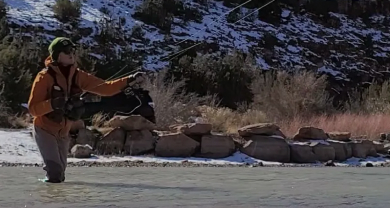
Nymphing : Starting the day, I decided that it would be fitting to start with a double nymph set up. My set up consisted of a medium size indicator, two weighted nymphs and some heavy split shot to help me hit the deep runs.
After making my first cast, I was taken aback at how well this rod can throw an indicator set up. Due to the fast action nature of the rod, I was able to comfortably cast my set up with ease. Even when approaching areas where I felt may require a longer cast, I was able to deliver my nymphs with accuracy. Its important to note that when fishing an indicator set up, there may be a lot of weight you are casting and having a faster action rod that allows you to do this with ease didn’t just make me feel more confident, but also made my time on the water more enjoyable.
Mending: Now, an essential part of nymphing is being able to mend, and while mending with the Sage Foundation, one will notice that the rod has the lifting power to throw a mend and get a more clean and natural drift. Thus making the rod great for nymphing.

Dry Flies: Once the day started to warm up I noticed a BWO hatch that was bringing tons of fish to the surface. After cutting off my nymph set up, I tied on a single 22 Parachute Adams. With my first few casts, I was not sure how much I was going to like using a fast action rod as my dry fly rod. Typically, I enjoy with a slow action or a medium action rod when fishing dries because it allows me to a get a delicate presentation. However, despite this I felt that I was still able to deliver a small dry fly to rising fish in winter conditions with success.
Now, fast vs medium or slow action rods can sometimes come down to personal preference. But, I will admit that I really enjoyed the power behind the Sage Foundation. For some of us that favor slow action rods, we are aware of the frustration that is brought on by casting into the wind. While using the Sage Foundation, I found that I had less frustration due to the rods ability to generate power and cast my fly into the wind. Therefore, I found myself often smiling that the ease of casting with this rod. Although it may not be as enjoyable as a a slower action rod, I highly recommend this rod and its action in certain conditions that require you to be fishing in some poor weather.

Consider the following, while fishing a specific run, I found a fish that was rising, but in order to make the cast, I had to cast into the wind to the other side of the river. Unfortunately, the water was relatively still, and I did not think that I would be able get close enough to the fish without spooking. Fortunately for me, the Sage Foundation was able to deliver enough power that I could make the cast and still present my fly in a delicate manner. After catching the fish, I realized that my slower action rods may not have had the power to cast directly in the wind with the same accuracy and delicacy. So, despite the fact that the Sage Foundation may not be the most fun to fish dries with, it is an absolute work horse, and I have confidence that this rod can throw small dries just as well as it can throw large hoppers.

Streamers: The final test that I had for the Foundation was to understand how it can throw a streamers. The streamer of choice for today consisted of a heavy cone head and measured about 3-5 inches. I would say that a streamer like this would be more on the maximum size of what a 5wt fly rod can comfortable cast. While casting this rod, you can quickly notice that all the power comes from the tip section. Other modern streamer rods are slightly slower than the Sage Foundation and generate most of its power from the midsection of the rod. While casting the streamer, I could feel that the rod tip is where the power is generated, and at times, it did not feel as smooth as compared to casting a streamer with a rod that generates power in the mid section. However, the Sage Foundation was still able to do a good job. As an all around rod, it is clear that the Sage Foundation can hold its own, even when casting streamers.
Closing Thoughts
In closing, some of the big takeaways that I have regarding this rod is the versatility. I really enjoyed taking the Sage Foundation on the water, and I never found any issues with the rod. At no point in the day did I every feel like I was underprepared for any situation. Regardless if I was casting dries, to setting up a heavy nymph rig, the Sage Foundation was able to do it all with ease and accuracy. After all of this, I do believe that the Sage Foundation is the best American made fly rod at this price point. Regardless if you are wanting to fish for carp, trout, small mount, or even sunfish, the Sage Foundation in an excellent choice due to its versatility and impeccable craftsmanship.
So you may be asking, ” who is this this rod good for?” Well, this rod is perfect for the angler that is looking to upgrade into a quality made fast -action American rod without breaking the price point. Alternatively, if you are considering this rod as your first rod, I would say that this is the best rod and reel outfit on the market. Again, the Sage Foundation Outfit is perfect for any new angler that wants a rod that will be reliable for many, many, years. With that being said, if you are in market to upgrade your rod or simply purchase your first rod and you are a fan of fast action rods, you can not go wrong with the Sage Foundation.
Sage Foundation ( Rod Only)
Sage Foundation Outfit


Sage rods have a hook keep. They are built in to the reel seat, two small holes on either side of the rod just below the cork. You’re welcome
I guess Orvis started this “no hook keeper” thing and I’m sorry to see it catching on. I’ve asked several Orvis folks why they did this (even on a $1,000 rod) and have gotten several different reasons none of which make a lot of sense to me. Of course, you can always use the stripper guide frame for this purpose but depending on leader length, the placement of a hook keeper might be more convenient. Why lose that option? Orvis told me that if I was so bold as to wrap a keeper on the blank myself, it would invalidate the warranty.
As to the alignment dots, they seem unobtrusive and handy to me – especially on a 4 piece rod and with aging vision If I ever bought a 4-piece without them, I’d be tempted to get a little white acrylic paint and rod finish to add them myself – unless of course that would also invalidate the warranty.
The result for me is that last year I passed on the Orvis Helios 3 and picked up a Scott Centrix which has both features. Similarly, I would probably pass on the Sage Foundation.